What I Learned From
Professor James DiCarlo About the Brain, Vision, and the Future of AI
.png)
5.
"Your research is moving from 'reading' the brain (understanding it) to potentially 'writing' to it (controlling neural activity with images). For a generation growing up with Neuralink and Apple Vision Pro, what are the ethical guardrails we should be thinking about now before this technology matures?"
Connecting to the previous question, there are definitely moral issues that can arise from the idea of “mind control.” It is critical that there be effective safeguards put in place to prevent harm. There is, of course, no true way to completely foolproof everything, but there are constant debates and discussion on the topic of the ethics surrounding the idea of controlling another’s brain.
4.
"I read about your work where you used AI to generate images that could control neurons in a monkey's brain better than real-world images could. That sounds almost like science fiction or 'inception.' Could this technology eventually be used to create 'digital medicine'—images that treat mental health issues by activating specific brain regions?"
There is currently work being done in the field, though Dr. DiCarlo certainly hopes it is possible. “I like to think I'm influencing your mind right now, and all I'm doing is there's photons hitting your eyes and some pressure waves hitting your ears, right?” he says, gesturing to the online call software. “The question is, are there ways to do it that we haven't thought of yet?” The goal is to find a method of reaching minds more powerful than what researchers have conceived of so far.
3.
"Your lab developed something called 'Brain-Score' to grade how brain-like an AI is. If you were to give today's most popular AI models a report card based on your research, what subject are they failing? Is it energy efficiency, learning speed, or something else?"
This is a difficult question to answer because this means that these LLMs would be treated as models of human intelligence, which is not their original purpose. The well-known “AIs” of today are very much not meant to be representations of the human brain, but rather simply new technology and tools to navigate the online world. In that way, scores of intelligence don’t apply at all.
2.
"We often hear that Deep Learning is 'inspired' by the brain. But as someone who looks at actual primate brains and computer models side-by-side, where does the analogy break down? Are the 'neurons' in a computer model actually doing the same mathematical work as the biological neurons you record in the lab?"
Math models can replicate a neuron the most closely, though the model becomes less and less accurate as the scale increases. Though a model of a single neuron may function similarly to the real thing, modeling an entire brain, a mind, a consciousness is more difficult. In addition, when building models, it can be very hard to tell what is an important or unimportant detail to account for in order to create the most accurate and precise replica.
Conclusion
“I say this is a science fiction story, but it's one that seems possible and could be explored,” says Dr. DiCarlo.
The intersection of neuroscience and digital technology is still a largely unknown gap, and the future remains to be seen when it comes to such a rapidly developing field. Despite the various questions and considerations to be discussed when it comes to neural models, ethics, and more, the current progress being made is exciting and hints at visions of a world of digital minds.
1.
"On your lab website, you describe your goal as 'reverse engineering' human visual intelligence. Students often learn about the brain bottom-up (neurons first) or top-down (psychology). Why is the 'engineering' approach—trying to build a copy of it to understand it—more effective for vision than just mapping every neuron?"
Dr. DiCarlo describes the engineering approach to the brain as having a “top-down spirit with engineering guidance,” analyzing the human brain and its mechanisms to convert it to a series of codable algorithms. He treats the mind like the end product of a complex machine, describing this brain replica system as a bridge between neuroscience and psychology.
During my interview with Dr. DiCarlo,
I was able to ask some unique questions related specifically to his work.
Interview Intro.
Can AI images be used as digital medicine to treat mental health?
And how is an iPhone app like the human mind?
I interviewed Professor James DiCarlo to find out the answers.
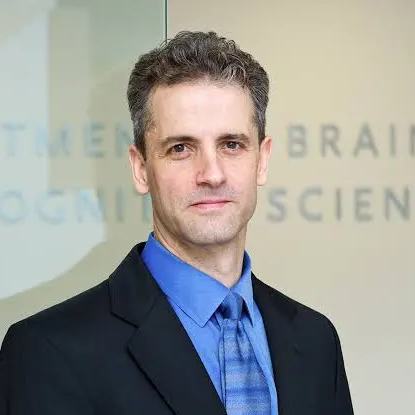
Professor James DiCarlo
Professor James DiCarlo is MIT's Peter de Florez Professor of Neuroscience and Director of the MIT Quest for Intelligence, and his research focuses on understanding how the brain makes sense of what we see. By studying how different parts of the brain work together, he and his collaborators have shown how the visual system can quickly and easily recognize objects in images. His team combines brain recordings, imaging, carefully controlled brain interventions, and machine-learning tools to build models that explain how visual processing supports thinking and behavior. This practical, engineering-style approach could lead to better artificial vision systems and AI, new brain–machine interfaces to restore or enhance the senses, and improved ways to understand and treat brain-related disorders.